
Assess Bitcoin Casino Offers Against the Rules
The guide explains the limits of Australian licensing and the practical trade-offs in bonuses, wallet transfers, confirmations and withdrawals.

What Australian Rules Say About Online Casinos
Australia’s online casino rules are directed principally at the businesses that provide the games, rather than at individual players. The Interactive Gambling Act 2001 makes it unlawful for an operator to offer certain real-money online casino services to people in Australia. The legal question therefore centres on what a service provides and whom it serves, not simply on where the company is based.
Australia does not issue a domestic licence for online casino games. A foreign licence does not become an Australian authorisation, and an offshore operator cannot treat its overseas status as permission to offer prohibited casino services to Australians. The Act applies to the provision of covered services to people in Australia; the location of a company’s website or its payment options does not, by itself, settle that issue.
This distinction matters when an online casino presents itself as available to Australian residents. A site may load, display Australian currency or describe its games as accessible from the country. Those features are not evidence that the operator is authorised under Australian law. Nor does the presence of a foreign licence put the service inside Australia’s regulatory framework. The relevant restriction is on the operator’s offer of the service to people here.
Operators
When looking for Bitcoin-accepting casinos in Australia, it is worth checking what each operator’s available details actually confirm. The notes below highlight the specific licensing, deposit or payout information provided for each option.
-
LuckyVibe
- License
- Curacao Gaming Control Board OGL/2023/176/0095 (Hollycorn N.V.)
LuckyVibe is listed with a Curacao Gaming Control Board licence, number OGL/2023/176/0095, held by Hollycorn N.V.
-
Playfina Casino
- License
- Curacao eGaming (Hollycorn N.V., since 2017)
- Min. deposit
- A$20-30 (depends on the offer)
Playfina Casino is described as operating under a Curacao eGaming licence held by Hollycorn N.V. since 2017. Its minimum deposit is A$20–30, depending on the offer.
-
MrPacho
- Payout speed
- crypto 30-120 minutes, fiat 24-72 hours
- Min. deposit
- A$30
MrPacho lists crypto payouts at 30–120 minutes and fiat payouts at 24–72 hours. The minimum deposit is A$30.
-
Uptown Pokies
- License
- Curacao (operating since 2017)
- Min. deposit
- A$20
Uptown Pokies is described as operating under a Curacao licence since 2017. Its minimum deposit is A$20.
-
Wild Tokyo
- License
- Curacao
- Payout speed
- crypto 30-60 minutes, fiat 1-5 days
- Min. deposit
- A$10
Wild Tokyo lists crypto payout times of 30–60 minutes and fiat payout times of 1–5 days. It has a Curacao licence and a A$10 minimum deposit.
-
Bizzo Casino
- License
- Curacao Gaming Control Board (TechSolutions Group N.V.)
Bizzo Casino is listed with a Curacao Gaming Control Board licence held by TechSolutions Group N.V.
-
Thor Casino
- License
- Curacao – Antillephone N.V. (Versus Odds B.V.)
- Min. deposit
- EUR 20
Thor Casino is listed under a Curacao licence from Antillephone N.V., with Versus Odds B.V. also named. Its minimum deposit is EUR 20.
-
Lucky Dreams
- License
- Curacao
- Min. deposit
- A$20 (POLi)
Lucky Dreams is listed with a Curacao licence. Its stated minimum deposit is A$20 via POLi.
-
WinSpirit Casino
- License
- Curacao eGaming OGL/2024/923/0383 (Antillephone N.V.)
- Min. deposit
- A$30
WinSpirit Casino is listed with a Curacao eGaming licence, number OGL/2024/923/0383, held by Antillephone N.V. Its minimum deposit is A$30.
-
Vegaz Casino
- License
- Curacao OGL/2024/1335/0780
- Min. deposit
- EUR 20
Vegaz Casino is listed with a Curacao licence, number OGL/2024/1335/0780. Its minimum deposit is EUR 20.
The Australian Communications and Media Authority (ACMA) has a practical role in enforcing the online gambling framework. It focuses on blocking offshore gambling sites that are not licensed for the Australian market. The agency has banned operators from Australia and arranged for their websites to be blocked. Blocking is a way of limiting access to services that fall outside the local rules; it does not turn an offshore operator into an Australian-licensed business or change the underlying legal status of the service.
A block can affect what a person sees when trying to reach a site, but accessibility and authorisation are separate questions. A website might remain visible through some routes or disappear from ordinary access after action by ACMA. Neither outcome is a licence. In particular, the fact that a site can be opened does not establish that its operator may lawfully offer online casino games to Australians.
The statutory focus on operators should also be kept separate from the position of players. Australian law does not make an individual criminally liable merely for playing at an offshore casino. That does not mean the operator is permitted to provide the service in Australia, or that the player receives the protections associated with an Australian licence. Crypto casinos, like other offshore casino services, do not hold a domestic Australian casino licence and operate outside the country’s local regulatory framework.

For that reason, a search for a Bitcoin casino in Australia does not change the first legal test: whether the business is offering online casino games to people located here. Bitcoin is a payment method, not a regulatory category that grants an operator permission to provide a service otherwise restricted by the Act. The same operator-focused framework applies whether a site describes itself as a mobile casino, a live casino or a casino that accepts cryptocurrency.
The legal landscape can also be confused by broad statements about gambling oversight. ACMA has responsibilities across gambling areas that include sports betting, lotteries and bingo, as well as casino games. That does not mean every form of gambling is treated alike. Online casino games provided to Australians remain subject to the specific restrictions in the Interactive Gambling Act, and the regulator’s blocking activity is directed at unlicensed offshore gambling sites.
The practical distinction is straightforward: an offshore website’s claims, payment methods and technical availability do not replace an Australian licence. There is no domestic licence for online casino games, and the law places the central prohibition on operators offering covered services to people in Australia. ACMA’s blocking action is one visible consequence of that framework, not a certification process for sites that remain accessible.
How to Assess Bitcoin Casino Offers Without a Ranked List
A comparison of Bitcoin casino offers in Australia starts with a distinction that marketing often blurs: an operator’s permission to serve customers in another jurisdiction is not an Australian licence. Australia does not issue domestic licences for online casino games, and crypto casinos operate outside the country’s regulatory framework. A foreign licence, where an operator claims to hold one, does not convert the service into an Australian-regulated casino.
That changes what “best” can sensibly mean. It cannot mean safest under Australian casino licensing, because there is no domestic licensing framework for these offers. Nor does a polished site, a large game catalogue or a cryptocurrency payment option establish Australian regulatory protection. Those are features of the offer, not evidence of local authorisation.
A practical comparison therefore separates facts about the operator from claims about the player experience. The operator’s legal entity, stated jurisdiction and licence details should be identifiable and consistent across its published terms. A licence claim needs to be checked against the named regulator’s own records; a logo or badge on a casino page is not independent confirmation. Even verified foreign authorisation describes oversight elsewhere, not approval to provide online casino games in Australia.
The same distinction applies to statements such as “available to Australian players” or “accepts Australian customers”. Availability is not the same as Australian licensing. A site can be accessible, accept a particular payment method or display Australian-facing material without becoming part of the local regulatory system. Treating those features as proof of legal status confuses access with oversight.
The operator’s terms are also part of the comparison, but not a substitute for checking its status. They should identify the entity responsible for the account and explain which jurisdiction’s rules govern the relationship. If the company named in the terms differs from the company shown in promotional material, or the licensing description cannot be matched to a regulator, the gap is material. An offer is difficult to assess when its responsible party is unclear.

Bitcoin does not alter this analysis. A casino may present itself as a Bitcoin casino, but a payment method says nothing by itself about the operator’s legal position in Australia. The same applies to claims about a “latest” site, a broad selection of Bitcoin games or a prominent bonus. These can be compared as commercial features only after the legal distinction is kept visible; none is a substitute for Australian authorisation.
A useful comparison sheet can therefore record separate fields: the operator’s legal name, the jurisdiction it says governs its service, any verifiable foreign licence, and the exact wording used about Australian availability. Keeping those entries apart prevents a foreign licence from being mistaken for local approval. It also makes unsupported claims easier to spot without turning a promotional ranking into a legal assessment.
There is no reliable way to turn these criteria into a ranked list of Australian-licensed Bitcoin casinos: that category does not exist under the domestic licensing framework. A “best Bitcoin casino Australia” label may describe a publisher’s selection or an operator’s marketing, but it should not be read as a regulatory status. The comparison can still clarify what an offshore offer claims and what can be verified. It cannot make an unlicensed service locally regulated.
Live Casino Games and the Limits of Australian Licensing
A live-dealer game can look different from a digital table game: a dealer appears on screen, cards or roulette results are shown in real time, and players interact through an online interface. That presentation does not change the legal category. When the service is an online casino-style game offered to people in Australia, the live format does not create an exception to the restriction.
The Interactive Gambling Act 2001 prohibits operators from providing online casino-style games to Australian residents. Its stated categories include poker, blackjack and roulette, alongside slots. A live stream of a dealer conducting one of those games remains an online casino service; adding a human dealer or a video feed does not turn it into a different kind of gambling service.
That distinction matters when comparing live tables with other online entertainment. The relevant issue is not whether the game resembles a physical casino, whether a dealer is visible, or whether the result is generated or displayed in a particular way. The issue is the underlying activity and the fact that it is being offered online to people in Australia. A live presentation changes the interface, not the operator’s legal position.
There is no Australian licence under which an operator can lawfully offer online casino games to Australian residents. The Interactive Gambling Act also bars operators from offering those games to residents under an Australian licence. Accordingly, a live casino cannot be treated as locally licensed simply because its website displays a licence from another jurisdiction or describes the tables as regulated elsewhere. A foreign licence does not displace the Australian restriction on providing the service to people here.
This is an operator-focused rule. It is the entity providing the online casino game that the Act targets. The regulatory question is therefore not answered by the presence of a dealer, a particular table format, or a payment option. Nor does a live-dealer label establish that the service is permitted in Australia. For a resident assessing a live casino, the central distinction is between the appearance of the product and the legal status of offering it to Australian customers.
Bitcoin does not alter that analysis. A casino-style game does not become permissible because a deposit is made in cryptocurrency rather than another method. The game category and the operator’s provision of the service are separate from the payment rail. A live blackjack table funded with Bitcoin remains an online casino-style game; the currency does not provide a licensing route or remove the operator’s obligation under Australian law.

The same reasoning applies to a live roulette table or online poker presented with a dealer on screen. The law’s treatment is not confined to games that use automated graphics. Where the service offered is one of the prohibited casino-style games, the format is not a workaround. The interface may be more theatrical, but the legal classification rests on the game and its online provision.
Descriptions such as “live,” “studio,” or “dealer-hosted” should therefore be read as product descriptions, not evidence of Australian authorisation. A site may explain how its tables operate or identify an overseas regulator, but neither point establishes permission to provide online casino games to residents in Australia. The absence of a domestic online-casino licence is decisive for that comparison: there is no Australian licensing status that makes a live-dealer offering lawful for local customers.
For Australian residents, live casino games sit within the same restricted category as other online casino-style games. The dealer’s presence may change the viewing experience, but it does not change the legal boundary.

Bitcoin Casino Bonuses: Calculate the Conditions Before the Offer
A bonus is not a cash amount until its conditions are applied. A Bitcoin casino deposit offer may add promotional credit to an account, but that credit can come with wagering requirements, game restrictions, a maximum cashout and payment-method exclusions. Each condition changes the amount that can actually be withdrawn. If any term is unclear, the bonus value cannot be calculated reliably.
Start with the wagering requirement. Check what amount it applies to: the bonus alone, the deposit, or both. Then identify which games count towards completing it. A requirement tied to a game category may not be satisfied by every game on the site, and excluded games can leave a balance that appears usable but does not advance the required play. The calculation depends on the written terms, not the headline offer.
Next, check the cashout rules. A maximum withdrawal attached to bonus winnings can cap the result even if the balance is higher. Look for any conditions that apply when the bonus is accepted, when it is used and when a withdrawal is requested. Also establish whether cancelling or declining the bonus changes access to the deposited funds. These details determine whether the offer adds usable value or merely adds conditions.

Payment exclusions matter for Bitcoin offers. Terms may specify which deposit methods qualify, and a promotion connected to one payment method may not apply to another. Confirm that Bitcoin deposits qualify before accepting the offer, and verify that the same cryptocurrency is supported for withdrawals. A bonus that can be claimed with one payment route but cannot be withdrawn through the chosen route is not a complete offer.
A no-deposit promotion still requires a close reading. “No deposit” describes how the bonus is granted; it does not establish that the resulting balance is unrestricted or withdrawable. Check wagering conditions, eligible games, any cashout cap and identity-verification requirements. Identity documents must be provided before withdrawals can be processed, so a promotional balance is not a substitute for completing verification.
The currency adds a separate calculation. Bitcoin’s price can move between deposit, play and withdrawal, changing the Australian-dollar value of both funds and winnings. Network transfers are irreversible, so a payment sent to the wrong address or network may be permanently lost. Those risks are independent of the bonus terms and should not be treated as part of the promotion’s value.

Legal status also cannot be supplied by a bonus label. The Interactive Gambling Act 2001 prohibits operators from providing real-money online casino games to people in Australia; an offshore promotion does not change that rule. Australian law does not specifically prohibit an individual from using an offshore crypto gambling site, but crypto casinos do not hold Australian licences. Anyone registered with BetStop or a state-based self-exclusion program must also self-exclude directly at each offshore platform.
The practical comparison is therefore a net one: qualifying payment method, wagering conditions, eligible games, cashout cap, withdrawal support and verification requirements. If one of those terms is missing or ambiguous, the offer has no dependable cash value to assign. A large promotional figure is packaging; the withdrawal conditions determine the amount.
What It Means for an Offshore Casino to Accept Bitcoin
A casino accepting Bitcoin is describing a payment method, not a legal status. The Interactive Gambling Act 2001 does not name Bitcoin or cryptocurrency. Its focus is the service being provided: operators must not offer prohibited online casino-style gambling to people in Australia. Taking payment in BTC does not change that distinction.
The operator’s position and the player’s position are not the same. There are no specific Australian laws prohibiting individuals from using offshore crypto gambling sites, and the prohibition under the Act rests on the entity offering the service. That does not make an offshore casino locally licensed or bring it within Australia’s regulatory framework. Australia does not issue a domestic licence for online casino games.
Accordingly, a casino site that accepts Bitcoin should not be read as an Australian-approved casino. A foreign licence, where an operator holds one, is not an Australian licence. Nor does a crypto payment make a prohibited service permissible for the operator. The relevant issue is the nature of the gambling service and whether it is offered to people in Australia—not whether the account is funded in BTC, another cryptocurrency or conventional currency.
The payment label also says little about the practical terms. Before any funds are transferred, the platform’s rules need to establish whether Bitcoin is accepted for both deposits and withdrawals, what identity documents are required before a withdrawal can be processed, and which network is supported. A mismatch between the casino’s required network and the one selected can result in permanent loss. Crypto transactions are irreversible, so an incorrect address or network is not a routine payment dispute.
Bitcoin’s price can move between deposit and withdrawal. A balance displayed in BTC may therefore have a different value in Australian dollars when it is later sold; the casino balance and the underlying asset price are separate calculations. The ATO treats cryptocurrency as an asset for capital gains tax purposes. Recreational gambling winnings are generally treated as windfalls rather than taxable income, but a gain in the value of BTC after acquisition can have a separate capital gains tax consequence.

Australian players are not specifically prohibited from accessing offshore crypto gambling sites, but that fact should not be confused with an assurance of consumer protection or a locally regulated service. ACMA blocks unlicensed offshore gambling sites, and access may be disrupted. A VPN should not be used to get around geo-restrictions; doing so may breach an operator’s terms and put an account or winnings at risk. People registered with BetStop or a state-based self-exclusion program must also self-exclude directly with each offshore platform.
The phrase “Bitcoin casino” therefore answers only how a platform may accept payment. It does not resolve the operator’s obligations under Australian law, establish local approval or remove the financial risks attached to crypto.
Starting a Bitcoin Casino Session: Wallet-to-Account Flow
A Bitcoin payment flow has two separate records: the casino account’s balance and the transaction recorded on the blockchain. A specialist casino review describes the basic route as a transfer from a personal crypto wallet to an address designated for the casino account. The blockchain records the movement of funds; it does not, by itself, establish that the account holder has met the casino’s account or withdrawal requirements.
The account stage comes first. A platform may require registration and identity checks, and identity verification documents must be provided before a withdrawal can be processed. The name and status of the account, the selected coin and the platform’s payment instructions therefore matter before funds move. “No-KYC” claims do not remove the stated requirement for identity documents at withdrawal.
Bitcoin Deposit Flow
-
1
Account Setup
Complete registration and provide required identity verification documents to ensure future withdrawals can be processed.
-
2
Address Acquisition
Copy the specific Bitcoin address provided by the casino for your account.
-
3
Wallet Transfer
Paste the address into your personal crypto wallet and transfer funds using the casino's supported network.
-
4
Balance Recognition
Wait for the required network confirmations before the casino credits the funds to your account balance.
For a deposit, the review describes copying the casino’s Bitcoin address into the sending wallet and transferring funds from there. The address must be checked carefully before sending: crypto transactions are irreversible, so a wrong address can mean permanent loss. The selected network must also match the casino’s stated requirements. A transfer sent on an unsupported network may not arrive as usable account funds.
The blockchain record can support transaction verification, but it is not the same as a casino credit. The platform must associate the transfer with the account, and its own rules determine how the balance is displayed. Deposit timing and network confirmations are separate operational details; the basic flow is simply wallet to designated address, then account recognition.
A withdrawal reverses the direction. The account holder requests a payout to a wallet address, subject to the platform’s process and identity checks. Before depositing, the casino’s withdrawal terms need to confirm that Bitcoin is supported for payouts, not only for deposits. A payment method available at the entry point is not automatically available at the exit.
Bitcoin’s value can change between deposit and withdrawal, so the amount shown in the account may not preserve the same value in Australian dollars. The blockchain records the transfer, but it does not protect against price movement or correct an address error.
The legal position is separate from the payment mechanics. Australian law prohibits operators from providing real-money online casino games to people located in Australia, and Australia does not issue a domestic licence for online casino games. The restriction is on the provider, rather than a general criminal prohibition on an individual player. Offshore access does not turn an unlicensed casino into an Australian-regulated service. A VPN should not be used to bypass geographic restrictions; doing so can breach platform terms and put account funds or winnings at risk. People registered with BetStop or a state-based self-exclusion scheme must self-exclude separately with each offshore platform.

Casino Games and the Scope of the Online Ban
The Interactive Gambling Act 2001 defines the issue by the game being offered, not by the currency used to pay for it. Its prohibition covers online casino-style games provided to Australian residents, including slots, poker, blackjack and roulette. A Bitcoin casino payment does not change the category of the service: the same game remains within the prohibition when the account is funded with BTC.
That distinction matters because a payment method can make a site look different without changing what it supplies. A casino may describe its balance in Bitcoin, or frame its games as crypto gambling, but the relevant question under the Act is still whether it provides one of the prohibited online casino-style games to people in Australia. The label attached to the balance does not redraw the boundary.
The named games cover different ways of playing, but they share the same legal treatment when offered online as casino games. Slots are included, as are poker, blackjack and roulette. The rule is therefore broader than a restriction on one particular game or one way of placing a bet. A site’s catalogue cannot be assessed solely by looking at whether it includes a specific title: the listed categories themselves are covered.

For anyone comparing bitcoin casino games, the useful distinction is between payment and product. Bitcoin describes how funds may be handled; it does not establish that a game is permitted for Australian residents. Nor does presenting a game as a crypto product make it a different kind of service for the purposes of the prohibition. The game category remains central.
This also prevents a common category error: treating a Bitcoin slot game as a special exception because it uses cryptocurrency. Slots are expressly among the online casino-style games covered. The payment method does not create an exemption, and calling the same activity a bitcoin game does not alter its substance.
The practical result is straightforward. The prohibition concerns operators providing the specified online casino-style games to Australian residents, not a separate class of games created by BTC. A casino’s list of games and its payment options are different questions; an answer about the latter cannot settle the former. For the legal classification, the relevant feature is the online casino game being supplied.

Bitcoin and Other Crypto Payments: Fees and Confirmation Trade-Offs
Choosing Bitcoin for a casino payment is not simply a choice between a familiar coin and an unfamiliar one. The network fee, confirmation pace and casino’s supported withdrawal options all affect the amount that reaches the account or returns to a wallet. These are separate costs: a low network fee does not establish that a casino will process a payment quickly, and a quick confirmation does not guarantee a low fee.
A specialist review reports that Bitcoin can take longer to confirm than Litecoin or Ethereum. That comparison is not a fixed timetable: network conditions and the fee attached to a transaction can change the outcome. The same review describes Litecoin as broadly accepted across crypto casinos and as having lower network fees than Bitcoin or Ethereum. Those reported characteristics may make Litecoin worth comparing, but acceptance and costs are not universal terms. The casino’s payment page is the relevant check for the specific coin and network it supports.
Ethereum presents a different trade-off. A specialist review notes that its transaction fees can exceed Bitcoin’s when network activity is high. That possibility matters because the fee reduces the value transferred, even if the casino credits the payment as intended. A fee estimate observed at one moment should not be treated as a standing cost for a later transaction.
The useful comparison is therefore net value, not coin price alone: the amount sent, the network charge, the expected confirmation conditions and whether the casino supports withdrawals in that same cryptocurrency. A Bitcoin casino may accept BTC for deposits without offering the same coin or network for payouts. That mismatch can leave the account balance usable only under different payment terms, so withdrawal support should be checked before any funds are sent.
Crypto prices also move against the Australian dollar. A balance’s AUD value can change between acquisition, deposit and later sale; the displayed coin amount does not preserve purchasing power. Separately, crypto transfers are irreversible. An incorrect address or network can result in permanent loss, so the destination and network must match the casino’s instructions before the transfer is authorised.
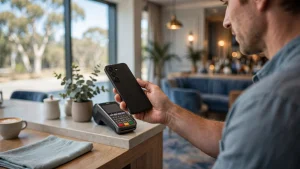
A casino payment method is not automatically preferable because it uses crypto. Bitcoin may offer a familiar route, Litecoin may carry lower network fees according to a specialist review, and Ethereum may become more expensive during busy periods, as another specialist review reports. The final comparison depends on the casino’s current payment terms and the transaction conditions at the time—not on a general label such as “fast” or “low-cost.”
Bitcoin Deposits and Withdrawals: Confirmation and Payout Timing
A Bitcoin deposit has two separate timing stages: confirmation by the network and crediting by the casino. A specialist review reports that one confirmation may take 10–60 minutes, with congestion and the transaction fee affecting the wait. The same review describes casinos requiring one to three confirmations before crediting funds; that is a reported practice, not a fixed rule across operators. The casino’s own deposit terms determine when a balance becomes available.
A withdrawal has a separate queue. A specialist review reports casino-side processing adding 12–48 hours before a Bitcoin payout is sent. That figure is a report from one review, not a dependable service standard. After dispatch, network confirmation and delivery to the personal wallet add further uncertainty. A displayed withdrawal request is therefore not the same as funds received.
Before depositing, confirm that Bitcoin is supported for withdrawals, not merely deposits. Check the receiving address and required network against the casino’s instructions: cryptocurrency transfers are irreversible, and a mistake can mean permanent loss. Identity documents may also be required before a withdrawal is processed. Bitcoin’s value can change between deposit and withdrawal, so the amount’s value in Australian dollars may shift even when the BTC balance does not.
Timing does not alter the Australian legal position. The Interactive Gambling Act 2001 prohibits operators from providing online casino-style games to people in Australia; an offshore licence does not create an Australian authorisation. BetStop or state-based self-exclusion registration also does not automatically cover offshore platforms: exclusion must be made directly with each platform.

A “no-deposit” promotion does not remove payout conditions. Before treating any bonus as withdrawable value, check its wagering requirements, game restrictions, cashout limit and excluded payment methods. Those terms can affect whether winnings are eligible for withdrawal, while confirmation and processing determine when an approved payout arrives.
Bitcoin Slots: What the Legal Category Covers
Bitcoin does not change how a game is classified under the Interactive Gambling Act 2001. A slot offered online for real money remains an online casino-style game whether the account is funded with Bitcoin, another cryptocurrency or a conventional payment method. The payment rail changes how value moves; it does not turn the game into a different legal category.
The Act prohibits operators from providing online casino-style games to Australian residents. Its named examples include slots, poker, blackjack and roulette. A Bitcoin-based version of a slot therefore remains within the category covered by that prohibition. Calling it a “Bitcoin slot” describes the payment or branding, not an exemption from the rule.
The distinction matters when a site presents its games as crypto-only or markets a separate catalogue of Bitcoin games. Those labels do not alter the operator-focused restriction. Nor does a foreign licence make an online slot lawful for an operator to offer to people in Australia under the Australian framework. Australia does not issue a domestic licence for online casino games.
This is also why searching for a licensed Bitcoin casino can produce a misleading shorthand. A licence issued elsewhere is not an Australian authorisation to provide prohibited casino-style games to residents. The relevant question is not which coin appears beside the game, but whether the service is offering an online casino-style game to someone located in Australia.
For pokies, the legal category is determined by the game and the service being provided, not by whether the interface displays a Bitcoin balance. The same applies to BTC slots and other crypto-labelled versions: the payment method does not remove the game from the Act’s scope. A change in currency is not a change in classification.
Are Bitcoin and crypto casinos legal in Australia?
Operators are prohibited from offering covered online casino games to people in Australia, and crypto casinos do not have Australian licences. Individual players are not made criminally liable merely for playing at an offshore casino.
Is it legal for Australian players to use Bitcoin at online casinos?
Australian law does not specifically prohibit individuals from using Bitcoin at offshore casinos. The legal restriction is on operators offering covered casino services to people in Australia, and Bitcoin does not change that.
Can I win real money at crypto casinos?
Crypto casinos can process withdrawals of winnings to a player’s wallet. Recreational gambling winnings are generally not taxable in Australia, though a later gain when selling cryptocurrency may be subject to capital gains tax.
What types of cryptocurrencies can I use at these casinos?
Bitcoin, Ethereum and Litecoin are accepted at crypto casinos. Bitcoin transactions may take longer to confirm than Litecoin or Ethereum, while Ethereum fees can rise during busy periods.