
Check the details before choosing an offshore casino
A practical guide to mobile access, licensing, Australian law, bonus conditions and payment routes at offshore casinos.

How Offshore Casino Play Works on Australian Mobiles
For Australian mobile users, an offshore crypto-friendly casino is more likely to open in a browser than through an app-store download. Browser access is the default because casino apps are rarely listed on Google Play or Apple’s App Store in Australia. Sites that accept Australian players typically rely on a mobile website or a Progressive Web App (PWA) rather than a native app.
These formats can look similar on a phone, but they are not the same thing. A mobile browser displays the casino’s website directly. A PWA is a shortcut to that website, presented in a way that behaves more like a native app. A native app, by contrast, is a separate application installed on the device. For this market, the practical choice is generally between using the site in a browser and adding a PWA shortcut.
Browser access
A browser session starts by opening the casino’s web address. The account used on a mobile browser is the same account used on desktop, so the mobile format does not itself create a separate player profile. The browser is the direct route: there is no need to find a casino app in an Australian app store or install a PWA first.
That distinction matters when assessing what a site means by “mobile app.” A page that opens in a browser is still a website, even if its layout is designed for a phone. A browser bookmark or home-screen icon may make the page easier to reopen, but it does not turn the site into a native application.

Browser access also keeps the format straightforward. The site is opened through the mobile browser, and the casino account is accessed there. The main comparison is therefore not between two different accounts or services, but between opening the website in the browser each time and creating a shortcut for quicker access.
What a PWA changes
A PWA remains a casino website. Its shortcut can sit on the mobile device and open in a manner that resembles a native app, but the underlying product is still the website. The installation process begins on the casino site: when an install or add-to-home-screen prompt appears, the user taps it and confirms. The shortcut is then available on the device.
This is a difference in presentation and access, not evidence that the casino has supplied a separately listed app. The PWA route is useful to distinguish from a download offered through an app store or from an installation file obtained elsewhere. If the site describes a web shortcut as an app, the label should be read according to what is actually being installed: a shortcut to the website.
A PWA can reduce the steps needed to return to the site, while browser access avoids setting up that shortcut. Neither format changes the account used on desktop. The deciding point is simply how the mobile site is opened and displayed.
Native apps and sideloading
Native casino apps are rarely available through Google Play or the Apple App Store in Australia. That is why an app-store search is unlikely to be the normal route to mobile casino access, and why browser play remains the standard format described for casinos accepting Australian players.

A casino may instead invite a user to download an app file directly from its website. That is sideloading, not an app-store installation. Sideloaded casino apps carry security risks, and their safety depends on the operator. A native-app appearance does not establish that the software is safe. The format alone cannot verify who controls the file or how it behaves.
It is also important not to mistake a PWA prompt for a sideloaded app installation. A PWA is added from the website using the install or add-to-home-screen prompt. A downloaded app file is a different kind of installation and carries the risks associated with sideloading. Where the installation method is unclear, the distinction should be resolved before proceeding rather than inferred from an icon on the home screen.
Access conditions still matter
The device format does not establish that a casino accepts a particular location. Before depositing, the site must be confirmed as accepting the player’s location. A page loading on a phone, or a PWA shortcut opening successfully, does not by itself establish that the account can be used from that location.
Using a VPN to reach a blocked casino may void winnings and lead to account closure. A change in apparent location is not a reliable substitute for confirming acceptance, and it can create an account problem rather than solve one. Access through a browser, PWA or downloaded app does not alter that risk.
There is also no Australian government body to complain to if an offshore casino refuses to pay winnings. That is a material limitation of the offshore arrangement, not a feature of any particular mobile format.
The practical summary is narrow: browser play is the default; a PWA is a website shortcut with an app-like presentation; and a native app is rarely available through Australian app stores. These formats describe how the service opens on a phone. They do not verify location acceptance, remove the risks of sideloading, or make VPN access safe.
Offshore Casino Sites: Licensing and Player Controls
A licence is an operator’s regulatory credential, not a guarantee that every account issue will be resolved in a punter’s favour. For offshore casino sites associated with Australian customers, Curaçao, the Malta Gaming Authority (MGA) and Gibraltar are jurisdictions that appear in licensing information. Their names identify different regulatory homes; they do not, on their own, establish how a particular site handles complaints, account restrictions or withdrawals.

The useful question is not simply whether a licence is displayed. It is whether the operator identifies the entity holding it, gives a way to verify the claim and explains which rules apply to the account. A badge in a footer is a starting point for checking, not the result of the check. If the operator’s name, licence details and terms point in different directions, the paperwork is not a minor inconvenience. It is the product.
What a licence can and cannot tell an account holder
Licensing information can help identify which operator is responsible for a site and which jurisdiction it says supervises its activity. That gives the terms context. It does not settle every practical question: account verification, accepted documents, withdrawal review, complaint handling and the consequences of a breached rule all depend on the operator’s published procedures.
A careful review separates the licence claim from the account conditions. The operator’s legal name should be identifiable, and the licence information should correspond to that entity rather than to a similarly named brand or an unrelated company. The account terms should also say which entity provides the service. Where those details cannot be reconciled, there is no sound basis for treating the licence label as meaningful protection.
Curaçao, the MGA and Gibraltar are common licensing jurisdictions associated with casinos that accept Australians. That does not mean every site linked to one of them has the same standards, controls or customer support. Nor does a jurisdiction’s reputation substitute for checking the individual operator’s documents. A site can present polished design and familiar payment branding while leaving the operative terms difficult to locate. The relevant evidence is the actual account documentation, not the visual confidence of the landing page.
A licence should also be kept distinct from the protections available to a customer in practice. The regulator named by an operator, any complaint route the operator describes and the operator’s own internal review process are separate things. The existence of one does not establish that the others are accessible or effective. The terms should explain how a dispute is submitted, what records are needed and whether the operator can restrict an account while it reviews activity.
For Australians using an offshore crypto-friendly casino, the practical risk is that there is no Australian government body to complain to if the operator refuses to pay winnings. A foreign licence does not create an Australian complaints authority. This makes clarity before an account is funded more valuable than a badge that cannot be connected to a usable process.
Account controls: settings, scope and effect
Responsible-gambling tools may be available as account settings, but their names matter less than their operation. Specialist reviews describe controls such as deposit limits, loss limits, wager limits, session-time limits and self-exclusion. Availability and implementation can differ by operator, so the presence of a control in a general description should not be taken as confirmation that it is available on a particular account.
A deposit limit is intended to restrict how much can be added to an account over a chosen period. The important details are when a change takes effect, whether a reduction applies immediately and whether an increase is delayed or requires confirmation. Without those mechanics, the label does not tell a punter how the setting behaves at the point it matters.
A loss limit concerns the amount an account may lose within the period defined by the operator. The terms should clarify what counts as a loss and how the period is measured. A wager limit instead concerns the amount staked. These are not interchangeable controls: a limit on stakes does not necessarily cap losses at the same amount, and a loss threshold does not by itself restrict the size of an individual wager.
Session-time controls address time spent in an account. Their value depends on what happens when the selected session ends: a reminder, a forced sign-out or another response should be stated plainly. A time prompt that can be dismissed without interruption is not the same control as one that pauses access. The interface should make the action and its effect clear rather than relying on a reassuring label.

Self-exclusion is a stronger restriction than a reminder or a limit. The key questions are how exclusion is requested, which accounts or products it covers, how long it remains active under the operator’s rules, and what happens to access while it is in force. The available details must come from the operator’s terms and account settings; a broad statement that self-exclusion exists is not enough to establish its scope.
These tools work only if the operator explains how they are set and changed. Before relying on any control, the account documentation should be checked for the relevant period, effective time and any steps required to confirm it. If a setting is difficult to locate or its effect is ambiguous, it cannot be treated as a dependable limit merely because the site lists it among its features.
Read the account rules before relying on safeguards
The account terms connect the licence information to the day-to-day handling of an account. They should explain identity checks, circumstances in which access may be restricted, how a customer can contact support and how a complaint is reviewed. These points are not decorative legal copy: they determine what evidence may be requested and what sequence follows when an account is questioned.
Consistency matters. The registration screen, account settings and formal terms should not give conflicting descriptions of a limit or exclusion. If a control can be activated in one place but the terms reserve a different process, the discrepancy should be resolved before relying on it. A safeguard that exists only in a promotional description is not an account setting.
Do
- Read full bonus terms for wagering requirements
- Verify if identity documents are required for withdrawals
- Check the operator's legal name and licence details
Don't
- Rely on a promotional headline for bonus rules
- Assume a licence badge guarantees payment
- Trust a safeguard that exists only in a description
The same discipline applies to offers. Before claiming a bonus, the full terms should be read for wagering requirements, game restrictions, expiry dates and cashout caps. Those conditions affect whether bonus-related funds can become withdrawable and what can happen if a condition is missed. An offer headline is not a substitute for the rules governing the account.
Operators may also ask for identity documents as part of account checks. The site’s privacy and verification information should explain what is requested and how the operator says it will be handled. The licence claim does not answer those questions. Nor should a punter assume that an account safeguard guarantees a particular outcome in a later payment or dispute.
A restrained test of operator claims
A comparison of offshore casino sites is more useful when it records verifiable details than when it treats a licensing jurisdiction as a ranking. For each site, the relevant questions are whether the responsible company is identified, whether the licence claim can be matched to that company, whether the terms are accessible and whether the account controls have clear operating rules. If one of these pieces is missing, the gap should remain visible rather than being filled with an assumption.
No label—licensed, responsible or best—changes the need to confirm that the site accepts the punter’s location before depositing. The claim should be checked against the operator’s own current account conditions, not inferred from a licence badge or a list maintained elsewhere. Access through a VPN does not cure a location restriction; using one to reach a blocked casino may void winnings and result in account closure.
Sideloaded casino apps carry security risks, and their safety depends on the operator. An app distributed outside an established app store should not be treated as safer simply because it resembles a familiar mobile product. The same principle applies to account controls: a feature is worth considering only when its terms and practical effect can be checked.

The comparison therefore ends with a documentary test, not a verdict based on jurisdiction alone. A named regulator may help identify the framework an operator claims to follow. It cannot replace clear account rules, usable control settings or a complaint process the operator has actually described.
What Offshore Gambling Means Under Australian Law
“Offshore” describes where a gambling operator is based, not a separate category of game or a guarantee that its services are lawful in Australia. In practical terms, an offshore casino is an operator outside Australia offering casino-style gambling to people located here. The location of the company does not determine the legal position by itself: the key distinction is between the rules applying to the operator and the position of an individual punter.
Under the Interactive Gambling Act 2001, operators must not provide real-money online casino games to people in Australia. The restriction covers casino-style games such as poker and table games, as well as other online casino formats. A site being hosted overseas, using a foreign business address or describing itself as an international service does not change that rule. The prohibition concerns the provision of the service to people physically in Australia.
That distinction matters because the Act does not make an individual Australian player’s use of an offshore mobile casino an offence under that law. The operator’s conduct and the player’s position are not the same legal question. It would therefore be inaccurate to read the operator prohibition as a statement that a player is committing an offence simply by playing. Equally, the absence of player liability under this Act does not turn the operator’s service into a lawful Australian casino.
The phrase “offshore casino legal” can blur those separate questions. A more precise account asks: legal for whom, and under which rule? In Australia, the Interactive Gambling Act prohibits operators from supplying online casino-style games to people here; it does not make individual players liable under that Act for playing at an offshore casino. The answer changes when the subject changes from the operator to the person using the service.
What the law addresses
The legal focus is on the supply of the gambling service. A business can be located outside Australia and still fall within the Act’s prohibition when it offers casino-style gambling to customers physically in the country. The customer’s physical location is therefore relevant; the operator’s overseas address does not create an exemption.
This is why “offshore” should not be used as a synonym for “outside Australian rules.” It identifies an operator’s relationship to Australia, but does not settle whether the operator may lawfully serve Australian customers. An overseas licence or a label such as “international casino” would not, on its own, override the Australian prohibition. The relevant point here is the rule on providing the service, not the operator’s marketing description.

The statute’s penalties also illustrate where the legal exposure falls. The maximum daily penalty stated for an individual who violates the Act is $360,000; for a body corporate, it is $1.8 million per day. Those figures relate to violations of the Act, not a penalty imposed on a player for using an offshore casino. Treating the operator-facing penalties as a player fine would confuse two different legal positions.
A person searching for a United States offshore casino is dealing with a different jurisdictional question. The words “United States” do not answer what rules apply to someone physically in Australia. For the Australian position, the location of the punter and the service offered are more relevant than a site’s country branding. No conclusion about United States gambling law follows from the Australian rules described here.
What the rule does not mean for players
For an individual player, the central point is narrow: playing at an offshore casino is not illegal under the Interactive Gambling Act 2001. That does not amount to an Australian approval of the casino, an assurance that a site is safe, or a promise that a dispute will be resolved. It describes the player’s position under this particular Act.
Age remains a separate condition. A person must be at least 18 to register and gamble in Australia. The fact that the Act does not make offshore play an offence for an individual does not remove that age requirement. Nor should the operator prohibition be read as permission for anyone under that age to take part.
Legal status and practical access are also distinct. The Australian Communications and Media Authority, or ACMA, takes active steps to block access to gambling sites that breach the rules. A blocked site is not evidence that an individual player has been charged or found liable under the Act. Blocking is an access measure directed at prohibited services; it should not be confused with a criminal penalty imposed on a customer.
Using a VPN to reach a blocked casino is not a legal workaround recommended here. Accessing a blocked service in that way may create account risks: the operator could close the account or void winnings. A VPN does not change the operator’s obligations under Australian law, and it does not make a blocked service an Australian-licensed casino. This is a risk warning, not an instruction for bypassing a block.
There is also a practical distinction between having no player liability under this Act and having an effective route to recover money from an offshore operator. If an offshore casino refuses to pay winnings, there is no Australian government body to which the player can complain for that payment dispute. That does not alter the legal rule about individual liability; it concerns the limits of recourse when the operator is overseas.
Reading “offshore” accurately
The meaning of “offshore casino” is geographical and commercial: it refers to a casino operator based outside Australia, or a service offered from outside the country. It is not a legal status that automatically makes the service acceptable for Australian customers. In the Australian context, the operator’s location and the legality of supplying casino games to people here are separate matters.
The same distinction applies when a site uses phrases such as “Australian players welcome” or presents itself as serving several countries. Those claims do not determine whether the service may be offered under the Interactive Gambling Act. The law’s restriction concerns the operator providing real-money casino-style gambling to people in Australia, not the wording used on a website.
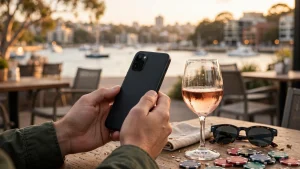
An offshore site may be technically reachable at one point and blocked later. Access can therefore change without changing the underlying rule. ACMA’s blocking activity concerns illegal gambling sites, while the Act sets the operator prohibition. Neither fact should be misread as proof that a player has committed an offence merely by visiting or using an offshore casino.
The legally accurate summary is limited but clear: Australian law prohibits operators from supplying online casino-style gambling to people in Australia; the same Act does not make an individual player liable for playing offshore; and anyone registering or gambling must be at least 18. A foreign address does not cancel the operator rule, while a block does not turn that rule into a player penalty.
Assessing Offshore Casino Offers for Australian Players in 2026
A polished interface or a large advertised bonus does not establish that a site will accept an Australian account, process a withdrawal, or resolve a payment dispute.
Location acceptance is a threshold condition, not a detail to confirm after registration. A site must be confirmed as accepting the punter’s location before any deposit. Access through a VPN does not change that requirement: using one to reach a blocked casino may void winnings and result in account closure.
First withdrawals commonly involve KYC checks, which may require a selfie or identification document and proof of address. The timing of those checks matters because an unverified account may not be able to receive a withdrawal.
Any bonus must be assessed from its written terms, not its headline value. Before claiming, the full conditions should be read, including wagering requirements, game restrictions, expiry dates and cashout caps. Each can reduce or eliminate the amount that can ultimately be withdrawn. If a condition cannot be located or its effect cannot be calculated, the advertised value is not a reliable comparison figure.
- Confirm the site accepts your current location
- Read the full terms for wagering requirements and cashout caps
- Check the identity documents required for the first withdrawal
- Verify the available payment routes for both deposits and withdrawals
Payment access and payment recovery are separate questions. A deposit route may be available while the withdrawal process remains subject to verification or other account conditions. Most importantly, there is no Australian government body to complain to if an offshore casino refuses to pay winnings. That leaves the punter relying on the operator’s own procedures rather than a local government complaint channel.
How to Read Claims About Top Offshore Casinos
A “top” label is a description, not evidence that a punter will receive winnings sooner or in full. For a financial comparison, the useful measure is the withdrawal ceiling and how it applies: a limit may be set per week or month, so the amount available for withdrawal can matter more than a headline ranking.
A specialist review reports that some casinos set weekly or monthly withdrawal limits, with figures in the range of $4,000–$10,000 per week. That is a reported example, not a market-wide standard. The operator’s own terms are the point to verify: check the limit, the period it covers, and whether it applies to all withdrawals or only particular account categories. If a large balance cannot be paid at once, a cap can extend the time before the full amount is received.
Claims about “fast payouts” do not answer this question. Processing speed and the amount permitted per period are separate conditions. A quick first instalment does not remove a low weekly ceiling; the remaining balance still depends on the stated limit and its reset period. A comparison that omits those terms leaves the key calculation unfinished.
Any casino presented as a recommendation is offshore and crypto-friendly, not an Australian-licensed service. Before depositing, the site must be confirmed as accepting the punter’s location. Using a VPN to reach a blocked casino may void winnings and result in account closure. There is no Australian government body to complain to if an offshore casino refuses payment. Bonus terms also need to be read before claiming, including wagering requirements, game restrictions, expiry dates and cashout caps. A ranking cannot substitute for those conditions; it is only as useful as the figures behind it.
A List Is Only Useful When Its Terms Can Be Checked
Operators
Choosing an offshore casino involves checking the details that matter to you, such as licensing information, deposit minimums and payout times. This list offers a concise reference to the information available for each operator.
-
LuckyVibe
- License
- Curacao Gaming Control Board OGL/2023/176/0095 (Hollycorn N.V.)
LuckyVibe lists a Curacao Gaming Control Board licence, OGL/2023/176/0095, held by Hollycorn N.V.
-
Playfina Casino
- License
- Curacao eGaming (Hollycorn N.V., since 2017)
- Min. deposit
- A$20-30 (depends on the offer)
Playfina Casino has been associated with Curacao eGaming and Hollycorn N.V. since 2017. Its minimum deposit is A$20–30, depending on the offer.
-
MrPacho
- Payout speed
- crypto 30-120 minutes, fiat 24-72 hours
- Min. deposit
- A$30
MrPacho lists crypto payouts at 30–120 minutes and fiat payouts at 24–72 hours. The minimum deposit is A$30.
-
Uptown Pokies
- License
- Curacao (operating since 2017)
- Min. deposit
- A$20
Uptown Pokies is listed as operating under a Curacao licence since 2017. Its minimum deposit is A$20.
-
Wild Tokyo
- License
- Curacao
- Payout speed
- crypto 30-60 minutes, fiat 1-5 days
- Min. deposit
- A$10
Wild Tokyo lists a Curacao licence and a minimum deposit of A$10. Its stated payout times are 30–60 minutes for crypto and 1–5 days for fiat.
-
Bizzo Casino
- License
- Curacao Gaming Control Board (TechSolutions Group N.V.)
Bizzo Casino lists a Curacao Gaming Control Board licence, with TechSolutions Group N.V. identified in the licensing information.
-
Thor Casino
- License
- Curacao – Antillephone N.V. (Versus Odds B.V.)
- Min. deposit
- EUR 20
Thor Casino lists a Curacao licence associated with Antillephone N.V. and Versus Odds B.V. Its minimum deposit is EUR 20.
-
Lucky Dreams
- License
- Curacao
- Min. deposit
- A$20 (POLi)
Lucky Dreams lists a Curacao licence and a minimum deposit of A$20 via POLi.
-
WinSpirit Casino
- License
- Curacao eGaming OGL/2024/923/0383 (Antillephone N.V.)
- Min. deposit
- A$30
WinSpirit Casino lists a Curacao eGaming licence, OGL/2024/923/0383, associated with Antillephone N.V. Its minimum deposit is A$30.
-
Vegaz Casino
- License
- Curacao OGL/2024/1335/0780
- Min. deposit
- EUR 20
Vegaz Casino lists a Curacao licence, OGL/2024/1335/0780. Its minimum deposit is EUR 20.
A list of offshore casinos is a starting point for checking terms, not proof that an account can be opened or a withdrawal completed. Any sites presented as options are offshore and crypto-friendly; neither label confirms that a particular service accepts Australian customers or supports a usable payment route.
Payment compatibility needs to be checked in both directions. A specialist casino review reports that some operators require withdrawals to return through the deposit method, while other methods may be restricted to deposits. That distinction can leave a balance without a straightforward cashout route if the payment option was chosen before its withdrawal rules were checked. The operator’s current cashier and payment terms are the relevant documents; a list entry alone cannot establish that a method remains available.
Account verification is another condition, not an administrative footnote. A first withdrawal may require identity documents, such as a selfie or ID, as well as proof of address. The account name and payment details should match the operator’s requirements before funds are deposited, since a mismatch can complicate verification.
Location eligibility must also be confirmed directly with the site before depositing. Access through a VPN does not resolve an operator’s location restriction: using one to reach a blocked casino may void winnings and result in account closure. If an offshore casino refuses payment, there is no Australian government body to which a customer can complain for recovery.
A useful list therefore makes its limits visible: which payment methods are deposit-only, what withdrawal route is permitted, and what documents are required. If these details cannot be checked against the operator’s terms, the listing has little practical value. A polished entry cannot substitute for a verifiable cashout process.
Offshore Casino No-Deposit Bonuses: Calculate the Conditions
A no-deposit label describes how an offer begins, not what can be withdrawn. The relevant figure is the amount of qualifying wagering required, together with the rules that decide which wagers count and whether any resulting balance can be cashed out.
A specialist review describes welcome-bonus wagering requirements in the 30x–50x range and treats requirements above 40x as steep. Those figures are a reference, not a promise about any particular offer or a guarantee that a no-deposit bonus uses the same terms. The offer’s own rules determine the calculation. They must specify the wagering base: a multiplier applied to the bonus alone produces a different obligation from one applied to a bonus plus a deposit.
The arithmetic is only usable once the remaining conditions are known. Check which games contribute, whether some are excluded or count differently, when the offer expires, and whether a cashout cap limits the amount payable. A large displayed bonus can therefore have little practical value if the qualifying play is narrow, the deadline is short, or the permitted withdrawal is capped. The final amount is controlled by the terms, not the headline.
This is an assessment of an offshore, crypto-friendly casino offer, not a recommendation to play. Before any deposit, the site must be confirmed as accepting the player’s location. A VPN used to reach a blocked casino may void winnings and result in account closure. No Australian government body handles complaints when an offshore casino refuses a payout.

For a clean comparison, record the wagering base, multiplier, eligible games, expiry date and cashout cap side by side. If any condition is unclear, the expected withdrawal cannot be calculated reliably. An offer with no deposit requirement is not cost-free when its conditions make the balance difficult or impossible to convert into cash.
Crypto-Friendly Offshore Casinos and Australian Payment Routes
Payment labels do not establish that a method will work for a particular account. A specialist review describes PayID, POLi, BPAY, cards and cryptocurrency as deposit options at some mobile casinos, but availability and processing times vary by operator. That is a report about specific services, not a dependable market-wide menu. Some Australian banks may also block or flag gambling-related card charges, so a card deposit can fail even when the cashier lists cards.
POLi is no longer a current route: its Australian operations ended in September 2023, and it no longer processes local transactions. A payment page that still displays POLi should be checked against the operator’s current instructions rather than treated as proof that the method is usable.
For crypto-friendly offshore casinos, the relevant comparison is not simply which coins are accepted. Deposit and withdrawal rules can differ, and some methods may be limited to deposits or require withdrawals to return through the deposit route. A specialist review reports crypto and e-wallet withdrawals being processed in under 24 hours. That figure concerns processing, not necessarily the time until funds arrive: an operator’s pending period and the payment network can add delay. E-wallets such as MiFinity, Skrill and Neteller are also used for deposits and withdrawals.
Before depositing, the site must be confirmed as accepting the player’s location. First withdrawals may involve identity checks, and bonus terms should be read for wagering requirements, game restrictions, expiry dates and cashout caps. Using a VPN to reach a blocked casino may void winnings and lead to account closure. If an offshore casino refuses to pay, there is no Australian government body to complain to. Payment speed is a narrow measure; it does not provide recourse if a withdrawal is disputed.
Do mobile casinos offer bonuses?
Yes, welcome bonuses are common. Check the wagering requirement, minimum deposit and expiry period; requirements are often 30x–50x, and many bonuses must be cleared within 7–10 days.
Can I play for free at Australian mobile casinos?
Yes, social and free-play casino apps with virtual credits are available in Australia through Google Play and the Apple App Store.
Is it safe to play at mobile casinos in Australia?
A mobile format does not prove that a casino is safe. Sideloaded apps carry security risks, and a displayed licence alone does not guarantee that account or withdrawal disputes will be resolved in your favour.
Can players limit their losses on mobile casinos?
Yes, responsible gambling controls can include deposit limits, loss limits, wager limits, session time limits and self-exclusion.
Is mobile casino gambling legal in Australia?
Playing at an offshore casino is not illegal for individual Australian players under the Interactive Gambling Act 2001. However, that Act prohibits gambling operators from offering online casino-style games to users in Australia.
Can I play mobile casinos for real money without an app?
Yes, most casinos accepting Australian players can be accessed through a mobile browser using the same account as on desktop. A PWA shortcut is optional.